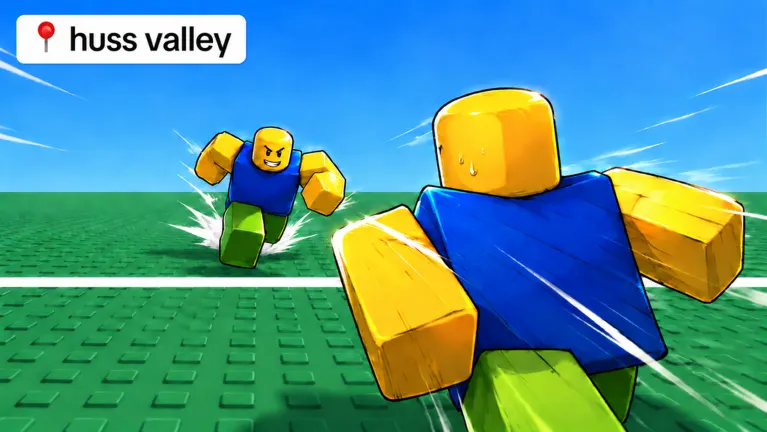
What Cartoon Characters Mean in Huss Valley
Huss Valley cartoon characters matter because appearances can be misleading during a fast round. The game does not center on a permanent cast of named heroes with fixed powers. Instead, players take on changing match roles while using their own avatar looks and cosmetic outfits.
A chicken, penguin, or other cartoon-like avatar is usually a visual choice, not a separate class. The important question is whether that player is currently trying to cross, stopping crossings, or helping their team recover. Knowing the distinction lets you react to what a player can do now instead of guessing from their outfit.
| Character type | Main purpose | How it appears |
|---|---|---|
| Runner | Reach the safe side of the field | Starts as part of the crossing group |
| Initial catcher | Prevent runners from crossing | Begins as the main chaser |
| Infected catcher | Expand the catcher team | Created after a runner is caught |
| Hero runner | Complete a difficult solo crossing | Appears in special high-pressure situations |
| Reviver | Help restore a teammate when possible | Depends on the round state |
The central match structure is an infection-style chase. Runners attempt to survive long enough to make the crossing. Catchers try to tag runners before they get there. Each successful catch can add another player to the catching side, making the remaining runners progressively easier to trap.
That changing team balance is why Huss Valley feels different from a game with traditional selectable characters. Your role can change during the same round, and the field becomes more dangerous as the catcher group grows.
Runner Characters and How to Play Them
Runners are the characters with the clearest objective: cross the map without being caught. Speed helps, but a direct sprint through the middle is often the easiest move for a catcher to predict.
The strongest runners create uncertainty. They watch the catcher’s facing direction, threaten one route, then break into another lane once the defender commits. A small delay or sharp turn can be more useful than constant zigzagging.
| Runner situation | Smart response | Why it works |
|---|---|---|
| A catcher guards the middle | Approach from an edge and cut inward if needed | The catcher has farther to travel |
| Another runner is being chased | Start your crossing during that pursuit | The catcher may be facing away |
| The finish is close | Keep moving until you fully cross | A last-second tag can still stop you |
| Catchers form a line | Look for a gap before committing | Charging the center is predictable |
| A teammate needs help | Assess danger before reviving | One rescue should not become two catches |
Good runner play is less about flashy movement and more about timing. If several runners hesitate at the starting side, do not automatically join the crowd. A large cluster gives catchers one area to watch and can make it easier to pressure multiple players at once.
Try to maintain enough space from teammates that a catcher cannot immediately turn one tag into another. At the same time, crossing near other runners can create useful confusion when the catcher must choose a target. The right answer depends on how many catchers are active and which lanes they control.
Useful habits for runner characters include:
- Watch where catchers are looking before beginning a run.
- Change direction to create a specific opening, not just to move randomly.
- Favor open edge lanes when the center becomes crowded.
- Save movement or deception tools until a catcher presents a real threat.
- Keep traveling after a near miss instead of stopping to celebrate.
- Confirm whether a revive is possible before assuming a caught teammate is gone.
In a hero runner situation, one player may need to make the crossing with much more attention on them. Patience becomes especially valuable here. Show movement toward one side, wait for catchers to shift, then use the newly opened lane rather than forcing an early attempt.
Catchers, Infection, and Team Pressure
Catchers win by denying runners a safe route across the field. The initial catcher has a major influence on the round because an early tag can quickly create a second catcher, then a third. That snowball effect is the heart of the infection system.
Once converted, infected catchers should think as a team. Chasing the closest runner is not always the best choice. Two catchers coming from the same direction often leave a wide lane open, while a spread-out group can force runners into predictable escape paths.
| Catcher approach | Best use | Common mistake |
|---|---|---|
| Direct pursuit | A runner has little room to turn | Continuing after the runner fakes a stop |
| Route blocking | Several runners are preparing to cross | Leaving an edge lane open |
| Pincer movement | A runner is isolated between teammates | Approaching from the same angle |
| Finish defense | Only a few runners remain | Standing too far from the crossing path |
| Group pressure | Runners are stalling together | Ignoring a hidden runner on the outside |
A catcher should predict where a runner will be next, not simply chase their current position. A player moving toward the left edge may reverse when pressured. A player standing near a crowd may use the group as cover before slipping into a different lane.
When there are only one or two catchers, target selection matters. Avoid being dragged into long chases that pull you away from the crossing route. When the infected side becomes large, spread out instead of forming a single pack. A tightly grouped group looks intimidating, but one runner can break in the opposite direction while everyone is watching the same lane.
Special round states can temporarily alter priorities. A revivable player, a hero runner, or an unusual objective may demand a different response than a normal crossing attempt. Catchers who notice that change early can prevent a round from slipping away.
Avatars, Cosmetics, and Character Confusion
The word “characters” can describe two different things in Huss Valley: the gameplay role a player has during the round and the avatar appearance that player has chosen. Keeping those ideas separate prevents a lot of confusion.
Cosmetics make players memorable. Animal-themed outfits and cartoonish bodies can help friends recognize each other, create jokes, or make a chase easier to follow. They do not automatically grant special movement, tagging, or revival abilities.
| What you see | What it usually means | What it does not prove |
|---|---|---|
| Chicken-style avatar | A cosmetic player appearance | A unique chicken class |
| Penguin-style avatar | A cosmetic player appearance | Special ice or speed abilities |
| Distinct outfit colors | Personal customization | A guaranteed team assignment |
| A player changing sides | They were caught and converted | They selected a new hero |
| A solo runner | A special round objective may be active | A permanent protagonist role |
This distinction is also useful when watching clips online. Videos may use “hussers” or show familiar cartoon characters in running memes, but those outside animations are not the Huss Valley game roster. They are separate meme content that borrows the game’s slang and chase-energy association.
For actual play, judge a player by their current behavior and position. Is that avatar moving toward the crossing zone? It is likely a runner. Is it blocking a lane or approaching runners from an angle? Treat it as a catcher threat, regardless of whether it looks like a bird, animal, or cartoon figure.
FAQ
Are Huss Valley cartoon characters official named heroes?
Usually, no. The game’s characters are mainly changing gameplay roles, including runners, catchers, infected catchers, hero runners, and revivers. Avatar outfits are generally cosmetic.
Do cartoon-looking avatars have unique powers?
A distinctive avatar does not automatically mean that player has a unique ability. Treat animal and cartoon-style looks as customization unless the game specifically identifies an ability or role.
What happens when a runner is caught?
The runner can become an infected catcher, helping the catching team stop the remaining players from crossing.
What is the best way to beat catchers as a runner?
Watch their facing direction, avoid predictable straight-line runs, use open lanes, and start your crossing when catchers are distracted by another player.
Why should catchers spread out?
Spreading out covers more routes and makes it harder for runners to escape through an unguarded edge lane.