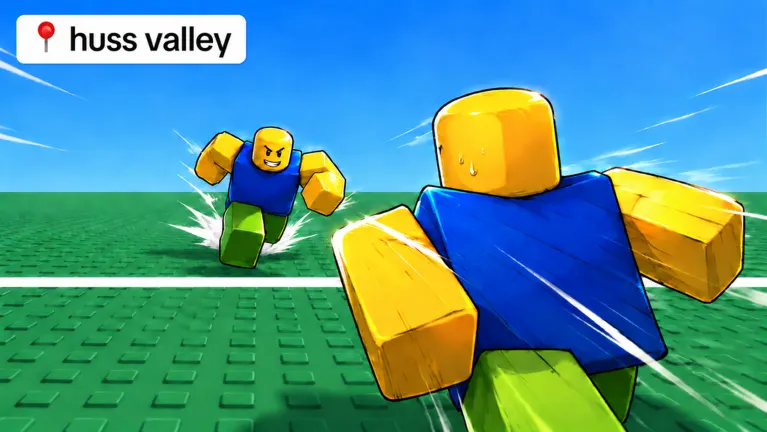
Start With Movement, Not Speed
Winning Huss Valley is less about holding forward and more about controlling momentum. Runners who understand acceleration, stopping, and lateral dashes survive longer, while Chasers who read those habits get faster catches.
The arena is a straightforward lane between two ends, but movement has weight. Your character accelerates gradually from a standstill and continues sliding briefly after you release movement keys. Treat every direction change as a commitment rather than an instant correction.
| Control | Default input | Practical use |
|---|---|---|
| Move | W, A, S, D | Build speed and position around opponents |
| Dash | Space while moving left or right | Make a quick lateral escape or reposition |
| Interact | E | Use applicable in-game interactions |
| Stop and turn | Release movement, then change direction | Break predictable movement patterns |
Spend a few rounds learning how far you travel before stopping. A sudden turn made too late can carry you directly into a Chaser's knife range.
Practice these habits early:
- Build speed before expecting a strong dash.
- Avoid running in a perfectly straight line for long stretches.
- Change your path before the Chaser reaches striking distance.
- Use the edges carefully; they limit your escape routes.
- Watch nearby players, since their movement can pull a Chaser away from you.
A dash is strongest when it changes the Chaser's prediction. If you dash simply because it is available, experienced opponents can wait for the move and follow your momentum.
Runner Tips for Reaching the Finish Line
As a Runner, your team needs to cross the arena three times without a capture. That means survival is collective: one player getting caught can end a promising push and add another Chaser to later rounds.
Your first priority is staying out of attention. At the start of a match, Chasers must choose among several Runners. Use that divided focus to cross cleanly rather than crowding the most dangerous area.
| Runner situation | Best response | Why it works |
|---|---|---|
| Chaser is far away | Keep a steady route and preserve your dash | You do not need to reveal your escape pattern |
| Chaser closes in | Dash away from their approach angle | Creates separation instead of moving into danger |
| Chaser follows closely | Make a sharp turn after gaining speed | Their momentum can carry them past you |
| Teammate is downed | Help only when the approach is safe | A rescue is not worth creating another capture |
| Late-round pursuit | Use turns and spacing more than straight speed | Runners can gain useful movement advantages later |
Try to maintain several character lengths of space between yourself and a Chaser. Once they are very close, your decision window becomes tiny. Dash away from the threat, not toward it; a forward-looking escape can still place you inside their attack route.
Sharp turns are especially effective when a Chaser commits to an aggressive line. Build momentum in one direction, then cut away and dash laterally. The goal is not to make the fanciest dodge. It is to force the opponent to turn, lose speed, and choose a new angle.
Do not repeat a rhythm. If you always run wide, dash at the same distance, and turn back toward the center, you become easy to anticipate. Alternate your timing, route, and escape side each round.
A downed Runner may be revived with a Rescue Kit when one is available. Before moving in, check whether the Chaser is waiting nearby. A rescue works best after a Chaser has committed to someone else or has been knocked away.
Chaser Tips for Creating Catches
Chasers win by converting every Runner into a Chaser. A knife hit can eliminate a Runner for the current round, and the growing Chaser side makes later rounds increasingly favorable.
The most common Chaser mistake is chasing every Runner at maximum aggression. Constantly sprinting behind someone gives them a clear cue to dash, turn, and lead you into open space. Instead, control the lanes that Runners need to cross.
| Chaser approach | When to use it | Main benefit |
|---|---|---|
| Passive interception | A Runner is approaching your lane | Keeps you ready for their dodge |
| Dash bait | A Runner is close but still has an escape | Encourages them to spend their dash first |
| Side or rear approach | A Runner has already passed your position | Reduces their ability to react cleanly |
| Group pressure | Several Runners travel together | Limits their safe routes and splits attention |
| Route denial | Near a likely crossing path | Makes Runners choose awkward turns |
Think like a goalkeeper. Position where a Runner wants to go, then wait for them to commit. When they dash first, their momentum becomes easier to read. That is often the moment to close the distance and attack.
Aim your movement ahead of a Runner instead of directly at their current location. They are likely to keep moving, turn, or use a lateral dash. Cutting off the next lane is more reliable than following their previous one.
Blind-side approaches are useful after a Runner passes you. Rather than immediately chasing from behind, reposition toward the side they are less likely to watch. A Runner focused on the finish line may not notice a Chaser setting up an interception from an angle.
Stay unpredictable as well. If you always wait in the middle or always rush the nearest player, Runners can plan around you. Rotate between lane control, delayed pressure, and ambushes.
Build a Smarter Loadout and Economy
Matches reward Gems and Coins based on performance. Gems can also appear on the map for Runners to collect, while Coins are used for consumable items. Knowing the difference prevents wasted currency.
Permanent abilities bought with Gems can give either role an advantage. Runner abilities focus on misdirection, escape, or knocking Chasers back, while Chaser abilities disrupt Runners and make catches easier.
| Resource or item | How it is obtained | Best purpose |
|---|---|---|
| Gems | Match performance and map pickups | Unlock permanent abilities |
| Coins | Match performance | Buy single-use consumables |
| Banana Peel | Purchased consumable | Trip an opponent, particularly useful for Chasers |
| Rescue Kit | Purchased consumable | Give a downed Runner a single-use recovery |
| Adrenaline | Purchased consumable | Improve acceleration and turning speed briefly |
You can equip only one consumable at a time, so select it for your role and comfort level. A Rescue Kit is valuable if you often play near teammates and can safely recover after a mistake. Adrenaline suits players who already understand turns and want extra acceleration during a chase or escape.
The banana peel is more about placement than panic. Drop it where an opponent is likely to travel, such as a narrow lane or the end of a turn. Throwing it randomly into open space is much less likely to matter.
The Hero or Chicken decision can appear for a Runner at the start of a round. Choosing Hero lets you attempt a solo crossing for a bonus reward. Choose it only when you are confident in your movement; the regular team round is often safer for players still practicing.
Avoid relying on connection tricks or intentionally disrupting your network. They can make matches unfair, cause unreliable results, and risk connection problems. Consistent movement practice is the useful advantage that carries from one match to the next.
FAQ: Huss Valley Tips
What are the best Huss Valley tips for new players?
Learn momentum before buying items. Practice building speed, making sharp turns, and using a lateral dash only when a Chaser is close enough to threaten you. As a Chaser, focus on intercepting routes instead of blindly following Runners.
How do Runners win in Huss Valley?
Runners win by reaching the opposite side of the arena three times without any Runner being caught. Team awareness matters because a capture converts that player into a Chaser in the following round.
When should a Runner dash?
Dash when a Chaser is close, about to attack, or has committed to your current direction. Dash away from their approach and use the gained space to turn or change lanes.
What should Chasers do against frequent dashes?
Wait for the Runner to dash first whenever possible. Their movement becomes more predictable after the dash, giving you a better moment to pursue, intercept, or attack.
Are Gems and Coins used for the same things?
No. Gems unlock permanent abilities, while Coins purchase consumable items such as Banana Peels, Rescue Kits, and Adrenaline.